Friday, 28 August 2015

4 Safety Tips for Night Driving


Wintertime brings various driving challenges, from wet, rainy conditions to wind, ice and snow. One factor you might not think about, though, is the length of the nights. The shorter days of winter mean there are more hours of darkness, and that translates to more driving time in the dark. Help ensure that you’re traveling safely on winter’s darker roads by following these safety tips for night driving.

Are you a safe driver? Hone Your Vision

Our pupils dilate in the dark, and our eyesight tends to detect lights and movement rather than the color and sharp details that we recognize during the day, according to experts. Consequently, our depth perception isn’t as keen at night, and our eyes may be more prone to become dry or tired because we tend to concentrate more and blink less.
With these physiological factors in mind, there are a few things you can do to make nighttime treks less treacherous. Eye doctors typically recommend scanning the road and keeping your eyes moving instead of concentrating all your vision on one area.
It’s also important to understand what you’re seeing. For example, if you’re traveling through a rural area that’s packed with deer, raccoons or other wildlife, two small, bright dots may be animal eyes in the distance ahead. Avoid hitting an animal by looking for reflections of your headlights in its eyes, which should be visible well before you can see the entire animal.
Make sure you’re getting your vision checked regularly, too. The American Optometric Association recommends getting your eyes checked every two years if you’re 18 to 60 years old, and annually after that.

Lighten Up

At night, the lights around you can work against you just as much as they work for you. Make sure that your headlights are aimed properly, since misaligned headlights can negatively impact your visibility and blind other motorists, according to the National Safety Council (NSC). Driving at dusk also poses greater risks than you might expect, since your eyes have to continually adjust as night falls. If the lights on your dashboard are on their brightest setting, it may  take a toll on your forward visibility. Dim your interior lights so that they are visible, but not distracting. That way, it will be easy for your eyes to adjust to the lights on the road ahead.
By the same token, avoid staring at headlights from oncoming traffic and other bright lights out on the road. It’s easy to get distracted by the high beams of a tall truck, or the glare coming off of an illuminated billboard. If you’re blinded by oncoming traffic, look toward the right edge of the road and steer along its path until you can see clearly again, the NSC suggests. If you are unsure whether your headlight settings are 100%, pop into a reputable motor dealer that is known for attention to detail, such as Group 1 Hyundai and have them help you.

Keep it Clean

Make sure that your headlights, taillights and turn signals are clean (and of course, clear of ice and snow), and ensure that your mirrors are also clean and properly adjusted. This can help maximize your ability to see what’s going on around you. Additionally, cleaning your windshield and windows with newspaper will help remove streaks that compromise your visibility at night, according to Popular Mechanics. Once your windows are clean, try to avoid touching them or wiping them off with your bare hand, since your skin’s oil can smear and create a glare when light shines in. Instead, keep a clean cloth in your glove box or center console, so you’ll have it handy when your windshield needs cleaning.

Stay Alert

It should go without saying, but distracted driving should always be avoided. Stop to stretch your legs and get food if you’re on a long trip, and if you’re tired, make sure you get some rest before heading back out on the road. It can be hard to judge how fast a car is traveling or how far away it is at night, so slow down and make sure that you are following other vehicles at a safe distance. Be mindful of other drivers, and switch to your low beams if there’s oncoming traffic or if you’re following another vehicle.
Whether it’s just after dusk, or right before dawn, these tips can help you take back the night.

South African roads in particular can be extra dangerous at night, so whether you drive a Nissan, Hyundai or a BMW, take note of these tips and be safe!

Sources : Article : http://blog.allstate.com/4-safety-tips-for-night-driving/

Tires Can Wear Out Even If They Haven’t Gone Very Far


I recently had a conversation with Johan Jooste – dealer principal of a prime motor dealership, Group 1 Hyundai in South Africa. South Africa is known for its potholes and dangerous roads. We started talking about his experiences with clients buying used tyres – hence me sharing this article with you. Great advice!
If you must buy used tires to outfit your vehicle, there are some important points to consider before you take the plunge.

A tire begins to diminish the moment it leaves the assembly line. Its first hundred miles is the best it will offer and it’s downhill from there. Between six and 10 years, its rubber and internal components will begin to get the tire equivalent of hardening of the arteries, often called dry rot. Tires are like humans that way: They can degrade and weaken even if they haven’t gone very far or done much. Prime example: your grandmother’s 9-year-old car may only have 10,000 miles on the odometer, but it needs new tires.

Tire Age

The tire industry argues that it’s nearly impossible to accurately determine age-related damage. That’s because a tire that waits for its first owner in a carefully climate-controlled tire-company storage warehouse is in something like suspended animation. However, one left in the sun on display may be almost worn out inside before it’s mounted on a vehicle. And the ones I put in the cool crawl space under my house in garbage bags are somewhere in between. Still, some tire companies recommend tires that have been in service for 10 years be replaced.

Testing with a match

You can measure safety by using a regular five-centimetre match, which has a 3 – 4-millimetre sulphur tip. The tip should disappear from sight when the match is placed into the groove. Test at several points around the tyre. If the sulphur remains visible, the tread is not safe for winter driving. We recommend a minimum groove depth of 4 millimetres.

History

While there is no way to track the history of a used tire, it’s safe to assume the used tires likely was driven under inflated. Also, a used tire could have suffered significant damage from a pothole, been repaired improperly, or permanently damaged when being dismounted. Make sure to have the used tire properly inspected by a tire professional before purchase and installation.

If you’ve just acquired a used car and face otherwise untraceable issues with tire wear, handling, excessive noise or the like, check to make sure all four tires were produced at the same plant at about the same time. It’s ideal if the reference numbers of the tyres are identical on all four tires and, if applicable, the spare.
Tire companies, like the manufacturers of just about every other product, often make changes during production runs and sometimes produce the same product in multiple plants. A tire made a couple of years after — or in a different plant than — its otherwise visually identical sibling may have subtle but important differences.

Remember to check your spare tire. (You may find you don’t have one!) It’s possible to have a spare that’s never touched the ground but is so old that it should be thrown away. And finally, to ensure your tires are properly inflated, we suggests you check the tire pressure of all your tires (even the spare) monthly.


Sources: Article : http://blog.allstate.com/tires-can-wear/

How to wash your Hyundai like the experts


We all know you love your Hyundai -  so why not take the best possible care of it?
Let’s start with the tools you’ll need to do the best job of washing your Hyundai vehicle, all of which can be purchased from a reputable DIY or car supply store.

For the engine:
  • Engine room cleaner
  • Cleaning towels or an Air Gun (if you have one)
For the interior:
  • Vacuum cleaner
  • Cleaning towels
  • Interior-specific surface cleaner

For the exterior:
  • Car wash soap (not household detergents).
  • Buckets
  • Sponges
  • A big paintbrush
  • Cleaning towels

Then, carefully follow these six simple steps:


Step 1: Clean the engine
  • For safety when cleaning the electrical components of your Hyundai, we recommend waterless washing
  • Spray the cleaner onto the engine and then wait for a while
  • Blow the engine cleaner off with an air gun OR wipe it away with cleaning towels

Step 2: Clean the interior
  • Remove valuables and carpets from the car’s interior
  • Vacuum the floors, floor mats, seats and all compartments
  • Also vacuum the door panels and the console
  • Wipe all surfaces and clean all vents with your paintbrush

Step 3: Rinse the exterior before a wash
  • Rinse the car’s exterior to remove all the large dirt particles first.

Step 4: Soap wash
  • Fill a bucket with car wash soap and warm water.
  • Using a wet wash cloth, clean the body of the car.

Step 5: Rinse soap away
  • Rinse the car with water until it is soap-free.
  • Do a final rinse if you’re not sure all the soap is gone.

Step 6: Dry and polish
  • Dry the car with a clean chamois cloth.
  • Only wipe the windscreen from left to right.
  • Then, apply tyre polish.

Pro tip: There are often sets of 4 and 2 in cars (tyres and side mirrors, for example). Clean things in sets, and you’ll save yourself some time.

Conclusion:
At Hyundai, we like to be thorough in everything we do – from perfecting our vehicle designs to manufacturing the tiniest car parts to the highest standard.
It’s why we’ve also added the following car-washing tips, so that you can wash your Hyundai thoroughly and safely, while still keeping it in perfect condition.
  • Always ensure that electrical extension cords are kept at a distance to avoid electrocution.
  • Try to use a washcloth instead of a sponge. Sponges have a habit of picking up granular dirt that can scratch your car.
  • Clean you washcloth after every wash.
  • After application, ensure that car soaps and cleaning liquids are removed prior to drying – dried soaps and cleaning material and soaps can cause damage to paint work.

Happy car washing.

Article submitted by Group 1 Hyundai, 450 16th Road, Randjespark, Midrand, Johannesburg
Source: Article and image : http://www.hyundai.co.za/hyundai-world/News/carwash/

Monday, 3 August 2015

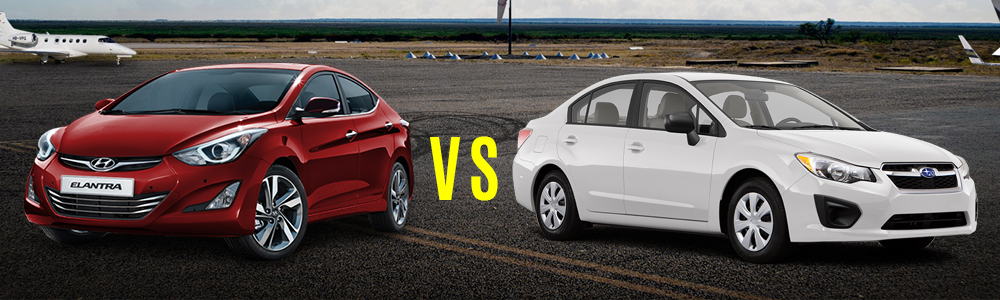
Hyundai Elantra vs. Subaru Impreza

Hyundai Elantra vs Subaru Impreza

When making a comparison between two giants of the motoring industry it is often a good idea to compare their most popular vehicles against each other. This is why we have chosen the Hyundai Elantra and put it up against the Subaru Impreza.


Which Vehicle Stays True to its Brand?

With Hyundai value for money has always been central to the way that they do business, and in the Elantra this still holds true. You get a lot of car for a lot less money when it is compared to other vehicles in its class. Subaru however still pride themselves in creating cars with the best all-weather capability. The Impreza offers this and more besides as its full-time all-wheel drive is powered by a 2.0-liter four-cylinder engine that puts out 148 HP and 145 lb-ft of torque.

The Verdict: This is a tie, as both the vehicles stay true to the core principles of the brand.

Who Wins the Power and Efficiency Competition?

This is where the first big surprise of the article comes in, as both the Elantra and the Impreza use a 2.0-liter four-cylinder engine. However the Hyundai offers the driver a little more power (173 HP) and torque (154 lb-ft). To compensate for this the Impreza does include a continuously variable transmission (CVT), but once it comes to high speeds it is the Elantra that runs away from the Subaru.

The Verdict: The Hyundai drivetrain might not be perfect, but it is perfect for this vehicle. Plus, it must be remembered that the Impreza’s permanent all-wheel drive does no favours to its fuel economy. The winner here is the Elantra!

Comfort or Visibility?

Thanks to its soft suspension and more comfortable seats the Elantra is the clear winner here. However, when it comes to visibility there is almost no other vehicle that can compare to the Impreza. The vehicle designers truly got things right here, as the thin A-pillars, boxy vehicle shape and door-mounted side mirrors make seeing where you’re driving as easy as moving your eyes.

The Verdict: If it is comfort you want then go for the Elantra, but if it is heightened visibility (which adds to the safety of the vehicle) then go for the Impreza.

Which Vehicle Offers the Best Styling?

Thanks to the Fluidic Sculpture 2.0 design language used to create the Hyundai Elantra’s looks you can rest assured that you are getting a vehicle that looks like a brand new, modern car. The Boxy design of the Impreza on the other hand is not very aesthetically pleasing and goes for the function-over-form look that Subaru is known for.

The Verdict: Hands down the Elantra, as the blocky body of the Impreza looks a bit dated.

Which Vehicle is More Practical?

Even though the Impreza is 4.7-inches longer than the Elantra in overall length it does not add to the overall practicality of the vehicle. This is because the mechanical components used for the Subaru all-wheel drive eat into this additional space. In fact, with 23.0 cubic feet of total space, the Elantra actually holds a half cubic foot advantage over the Impreza.

The Verdict: This is a tough one, because if you fold the rear seats of the Impreza down it does regain a bit of a size advantage inside. The Subaru also offers an inch more rear legroom than the Elantra, which means that when it comes to space for passengers the winner is the Impreza.

Which Vehicle has the Best Interior Design?

The Subaru Impreza is sold and dependable, but in this department the Hyundai Elantra really shines! Similar in looks to the luxurious Sonata, the Elantra has buttons and touch screen controls that are intuitive to use. The inside of the Elantra also looks and feels like it is of a higher quality than the Subaru’s.

The Verdict: This is a bit of a no contest, as the Hyundai easily walks away with this one.

Which Vehicle Scores Highest in the Safety Evaluation?

The Subaru Impreza consistently ranks at the top in crash tests, but the Elantra is no slouch either, earning a Top Safety Pick rating by the IIHS. That said, the Impreza is ranked higher with a Top Safety Pick+ rating.

The Verdict: The Impreza, but it does come at a financial cost as the Subaru is more expensive than the Elantra.

The Overall Verdict

The Subaru Impreza is an impressive vehicle and offers top notch safety and all-wheel drive. However it simply cannot beat the Elantra’s style, comfort and value. Hyundai has made a name for itself as a company that offers value and reliability, but now you can also add the words refinement and quality to the mix thanks to the 2015 Hyundai Elantra.

You Hyundai Elantra is waiting for you at one of the worldwide, world class Hyundai Dealerships, such as Group 1 Hyundai in Johannesburg. Test Drive one today!

As published on: Hyundai Drivers

Thursday, 25 June 2015

Expressing your emotions while driving? Distracting or Mood-lifting?

Using emojis on your Hyundai i10, or Nissan Qashqai’s window to express ‘thanks’, ‘annoyance’ or ‘happy’ could be adding to the array of digital gimmicks already distracting drivers from the road and can not help to wonder if you will see more angry faces than smiles on South African roads! What do you think? Read more below.

This Startup Wants to Make Driving More 'Social' With Light-Up Emojis for Your Car

If a growing arsenal of devices has come to serve as a constant conduit for self-expression and engagement in our hyper-social era, why should cars be any different?

As the so-called Internet of Things edges towards wider adoption, that’s the conceit of two-year-old MotorMood, an Orange County-based startup that wants to make the road a happier place.

The company’s first product is a light-up smiley face that affixes to a vehicle’s rear window in order to say ‘thank you’ to -- and perhaps even flirt with -- fellow drivers on-the-go. Visibility ranges up to 30 feet, the company says.

Priced at $30, the emoticon illuminates for six seconds thanks to a remote control button that clips onto sun visors, not unlike a garage door opener. It requires less concentration to operate than a radio or air conditioner, according to MotorMood.

The company launched a Kickstarter campaign today with a lofty $130,500 goal; the team of four co-founders chalks the figure up to high manufacturing costs.

Nevertheless, they are confident it will be surpassed: A 1,050-person self-conducted survey validated a sort of delighted intrigue in the product, they say, and existing research confirmed that smiley faces not only trigger the same emotions as human smiles, but also have the power to reduce anger and aggression in teens.

The product’s chief demographic, according to the team’s survey, is females aged 18 to 29.

But a light-up ‘thank you’ is really just MotorMood’s first act, explains 28-year-old co-founder and president, Jesse Kramer. While additional happy emojis, themed collections and even licensed characters are potentially next on deck (despite requests, MotorMood won’t ever produce middle fingers or angry faces, he says,) Kramer eventually envisions a Bluetooth-connected device with a Kindle-like display that could serveas “a status bar for your car.”

In this sense, its use cases are endless, adds Alex Sewell, 22, a co-founder who serves as vice president of operations. Future iterations could track the number of smiles given and received via a corresponding app, or even identify the kind of music playing on one’s radio, Shazam-style, and display that information like a real-time bumper sticker. (If you’re wondering why anyone would ever care to share such information, just think of the glut of minutiae that currently stampedes across social media every second.)

Even further down the line, adds lead engineer Arman Bastani, 41, another co-founder, MotorMood could act as a data-collecting censor in realms like air quality and traffic alerts.

MotorMood’s fourth co-founder, Kina de Santis, met Kramer and Sewell at a startup event in Orange County, Calif. As the company’s director of marketing, she was also recently recognized by the Global Student Entrepreneur Awards.

“Everyday, you’re stuck in your car. You’re isolated by barriers of glass and steel,” says de Santis, 20. “And you’re so used to being able to share your emotions all the time.”

Once a smile is spotted, describes Kramer, MotorMood yields an element of surprise that feels almost magical for bestower and receiver alike. “You see something light up out of nowhere, and it ignites this sense of wonder, enjoyment and happiness.”

Found on : www.entrepreneur.com (Writer: Geoff Weiss)

Image credit : Motor Mood

Monday, 1 June 2015

Hyundai Veloster gets a boost from a 150kW Turbo Engine

The Hyundai Veloster range in South Africa has received a shot in the arm with the addition of a turbo boosted direct petrol injection engine, along with more sporty and luxury features that makes this attractive hatchback a well rounded sports package.

At its global launch the Veloster Turbo was the first Hyundai to feature the company’s 1,6-litre GDI engine with a high-compression, twin-scroll turbocharger. This T-GDI unit, generating 150 kW maximum power and 265 Nm of torque, has now made its debut in the local Veloster range, with performance figures that are quite a step up from its non-turbocharged sibling which delivers 103 kW and 167 Nm.
“The Veloster Turbo is also pointer to where the Hyundai brand is heading: to produce vehicles with advanced engine and transmission technology that will appeal to car buyers that are looking for an exciting, yet reliable and well-designed automobile. The engine used in the Veloster Turbo forms the base for the power plant in Hyundai Motorsport’s World Rally Championship i20 car – the only difference is that the rally car delivers 200 kW .,” says Stanley Anderson, marketing director of Hyundai Automotive South Africa.
“The heart of the Veloster Turbo is its powerful engine, and the performance that it injects into this innovative sports hatchback in our range. You can watch this space, for this engine is the start of many new developments to come from Hyundai’s Namyang Research and Development Centre in South Korea,” says Anderson.
Maximizing fuel efficiency and performance, the Hyundai Veloster Turbo’s engine has an air-guided intercooler, direct fuel injection system and dual CVVT, with a bed plate and a serpentine auxiliary belt adopted for enhanced engine reliability
The Veloster Turbo is fitted with a quicker-ratio steering rack and a revised steering calibration to match, which provide for precise cornering, feedback and control.  As with the turbocharged engine, the front and rear suspension set-ups have been tuned to match the expectations of drivers that appreciate firm and surefooted road manners.
The driving experience is further enhanced by the sport-tuned engine intake and exhaust notes: the trapezoidal centre tailpipes of the normally-aspirated Veloster have been replaced with two larger free-flowing circular pipes, allowing for a more robust sound.
To handle the power enhancements, the Veloster Turbo is paired with a standard six-speed manual transmission – developed in-house by Hyundai – featuring a wider gear ratio spread to handle the additional torque output. It also comes with a seven-speed Dual Clutch Transmission (DCT) which changes gears automatically or through driver input with steering wheel mounted paddles or the gear lever.
“The Veloster Turbo is not only about power and performance on the road – it is a well-equipped hatchback with a long list of luxury features, from the sound system with its Gracenote music management feature to leather seats, and Bluetooth sound system and cell phone integration. Furthermore, it has scored exceptionally well in the safety ratings of the Euro NCAP crash tests,” says Anderson.
The Veloster Turbo has the same practical appeal as the original model, thanks to the innovative 1+2 door design. It also now features unique front and rear bumpers and fog lights, a new rear spoiler and grille, new 18-inch alloy wheels, projection headlights with unique LED headlight accents, and unique LED taillights. These elements further accentuate the car’s eye-catching styling and add a greater emphasis on its performance.
Why not Book a Test Drive today at an approved Hyundai dealership such as Group 1 Hyundai in Midrand?
Article as published on http://www.3D-carshows.com
Written by Johann Verster (Motoring Journalist)

Sunday, 31 May 2015

Offensive Car Names: Is It Really a Problem?


We all remember Shakespeare’s Juliet asking Romeo “What's in a name? That which we call a rose by any other name would smell as sweet,” but when it comes to auto brands and car names it is a completely different story! Over the last few decades car makers have been criticised for offensive car names, mocked for translation errors and forced into boring naming conventions. But is it really something that car makers should be that worried about?


As you can expect, large car makers spend millions each year coming up with names that are supposed to evoke passions and emotions in us, driving us (excuse the pun) to want to buy that particular car. The more memorable the branding the more likely you are to buy to – getting a brand to be a household name is the holy grail of branding. And yet, even with all this emphasis on branding there are still countless names that make you cringe. Take for example the Jeep Cherokee. For most people in South Africa, this is just a harmless name, but for the Cherokee nation in North America, having a vehicle named after them without consultation can be offensive and yet this happened to with the Pontiac Aztek, the Jeep Comanche and the Mazda Navajo. Imagine what would happen if an automaker brought out a vehicle named the ‘Xhosa’ or ‘Afrikaner’?

Other times the name becomes silly, offensive or rude due to unforeseen translation problems. The Audi E-tron is a beautiful car, but if you spoke French you’d probably read it as the Audi étron which translates to ‘shit’ in English. The same goes for the Mazda Laputa (Spanish for ‘the whore’), Nissan Moco (Spanish for ‘snot’) and the Mitsubishi Pajero (Spanish for ‘wanker’).  Here in SA we seem to have missed the majority of translation errors with the closest being the Range Rover Evoque, which with the right Afrikaner accent and determination could come out as the ‘e-fok’ or the Volkswagen Amarok which turns into ‘I’m-a-rock’ which could give Afrikaners second thoughts.

To combat these faux pas many car brands are shifting towards names that are numerical or are neologisms. Think about the Hyundai range of i-vehicles such as the Hyundai i10, Hyundai i20 etc, BMW’s entire range as well as Mercedes’. Of course this isn’t proof against incident. Take the Toyota MR2 for example – pronounced in French it comes out as ‘merde’ or ‘shit’, the BMW 530d (read it upside down and back to front) or the Hyundai ix35 which when read backwards is supposed to read ‘sexi’ (which might not be offensive but is close). Other brands opt for neologisms such as the impossible-to-spell-right-on-the-first-try Nissan Qashqai, or the Hyundai Veloster.

The sad thing is that as much as I like neologisms when it comes to branding, there are so many car names and brandings that have become so ingrained with the brand that I forget that it could cause offense. And you know what? I’m finding it harder to care anymore when somebody points out that if you added three numbers to Clarkson’s licence plate and divided it by pi it almost equals the approximate number of people who stubbed their toes in the Falklands war. Names and numbers have history yes, but they also have the have the ability to shape new meanings. When I think about the Jeep Cherokee, I’m not thinking about the Native American Indian Nation. I’m thinking about how great it is for soft off-roading, and when I think about the Ford Escort, I’m not thinking about Harrison Ford with prostitutes but rather it being my friend’s first car and all the fun we had with it.

So yes, names have value and sometimes the meanings get lost in translation, and if you really want to be offended by them chances are that you will find a way, but maybe the more important meanings are the ones we give to them going forward? Now if you excuse me I’m going to try and persuade somebody to get working on the tongue-twistingly awesome Isuzu Zulu SUV.

Written by K C Myer
As published on: https://hyundaidrivers.wordpress.com/